
The Hidden Cost of Putting Things Off
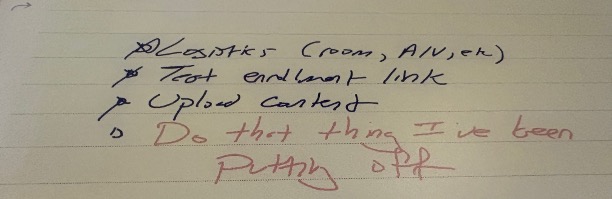
Four little boxes. Three checked, one not.
So it moves to the next day. Then the next. Then the day after that.
I have one of those. It's a decision I've been putting off for quite a while. Every morning, there it is, staring back at me from my task list.
I've been punting it like Ohio State on a bad day.
This happens all the time. We put off decisions because we need more information, the timing isn't right, or we just… ugh… don't want to deal with it right now.
I call this decision baggage.
And like actual baggage, we have a remarkable ability to accumulate it.
The decision doesn't go away. It stays attached, like a little barnacle. And over time, these little suckers add up.
But why do we do this to ourselves?
The Decision Isn't Always the Problem
I've been thinking about what's behind my own decision baggage.
For me, it often comes down to rejection.
The possibility that I'll put myself out there, take a chance, ask for something, or pursue an opportunity only to hear no.
And that makes a ton of sense.
I've experienced rejection and I'm particularly sensitive to it. A lot of that has to do with childhood I think. So why wouldn't I want to avoid it?
For you, it might be something else. Fear of failure. Disappointing someone. Conflict. Regret. Or perhaps the uncomfortable realization that making one choice means letting another possibility go.
There's some fascinating psychology behind this.
Psychologists Timothy Pychyl and Fuschia Sirois have studied procrastination as a form of emotional regulation. Their work suggests that putting something off often has less to do with managing time and more to do with managing how we feel.
When we're faced with something uncomfortable, postponing it gives us immediate relief.
And there's the trap.
The decision hasn't gotten any easier. We've just temporarily escaped the discomfort of facing it.
In my case, I can spend a very productive day checking off tasks while leaving the one decision that matters untouched.
I used to tell myself I was prioritizing more important things and sometimes that's true.
But sometimes I'm choosing the easy things to avoid the hard thing.
The Cost of Carrying It
Here's something I found particularly interesting.
Researchers E. J. Masicampo and Roy Baumeister studied what happens when we leave goals unfinished. Their research found that unfulfilled goals can remain cognitively active, creating intrusive thoughts and interfering with other work.
Ever been enjoying dinner and suddenly remembered that conversation you still need to have?
Or found yourself thinking about an unresolved problem while trying to focus on something completely unrelated?
That's part of the baggage.
Psychologist Sophie Leroy has explored a related phenomenon called attention residue. When we move from one task to another, some of our attention can remain attached to what we left behind.
Not every unfinished decision will haunt us, of course, but some refuse to stay quietly in their little boxes.
We keep carrying them, even when we're doing something else. That little barnacle just siphons off our time and attention on the thing we're trying to focus on.
And there's another cost that's easy to miss.
Punting off a decision is, in itself, a decision.
When I put something off, I'm choosing to continue with things as they are, at least for now.
Sometimes that's perfectly reasonable but sometimes circumstances are changing while I'm busy not deciding.
The opportunity moves on. The relationship changes. The deadline passes.
Which brings me to something I've been wrestling with:
We often mistake avoiding a decision for preserving our freedom to choose.
But what if our delay is actually narrowing our options?
Putting Down the Baggage
So what do we do?
The obvious answer is to make the damn decision.
But I think there's something more useful here than simply telling ourselves to be more decisive.First, we need to understand what we're avoiding.
When I look at that unchecked box, I can ask myself a different question.
Instead of Why haven't I done this yet?
I can ask, What am I afraid might happen if I do?
For me, the answer is often rejection.
Once I recognize that, I can examine it. Is rejection really as awful as I'm making it out to be? What would it actually mean? And what might become possible if I were willing to experience it?
This isn't about pretending the fear doesn't exist, it's about recognizing that fear is part of the decision, not necessarily a reason to avoid it.
Second, I can choose what to do with the decision itself.
I might have enough information to make the call right now.
I might genuinely need more time, in which case I can decide what information I need and when I'll revisit it.
Or I might decide that I'm perfectly content leaving things as they are.
That's a legitimate choice, too.
Here's the interesting part: Masicampo and Baumeister also found that making a specific plan for an unfinished goal could reduce the cognitive interference it was creating.
We don't always have to finish something to stop carrying it around in our heads - sometimes we simply need to give it a place to land.
Instead of dragging the same unchecked box into tomorrow, I might schedule time to gather the information I need, have the conversation, or make the call.
A conscious decision about when to decide can be a meaningful step forward.
Of course, there's a catch.
If I keep moving that date, I've just created a more sophisticated way to procrastinate. And I'm pretty good at that, too.
One Less Thing to Carry
I'm still working through the decision that inspired this essay.
I know what I need to do. I also know that part of me would prefer to keep that little box unchecked, because as long as I haven't acted, I haven't risked hearing no.
But there's a cost to that comfort.
I don't think every decision needs to be made immediately. Sometimes patience is wisdom. Sometimes more information really does matter.
And sometimes we're just avoiding an unpleasant feeling.
The challenge is being honest enough with ourselves to know the difference.
So here's something worth considering.
Think about a decision you've been carrying. One that keeps finding its way onto tomorrow's list.
What makes that decision uncomfortable?
What are you hoping to avoid?
And perhaps most importantly, what is choosing not to decide already costing you?
I still have that fourth box to check.
Maybe today.



Responses